Join today
Certificate Programme in Direction
This Program will teach you how to successfully transfer that story you have in your mind to the paper, and eventually to the big screen. This is where a movie starts and is where we will start our journey to understanding filmmaking.
Format
Online
Programme
Price
₹15,000
What you are going to learn
A few more words about this course
Through this Certificate programme in Direction, you will learn the skills required to become a successful director. You will learn how to think like a director, how to find your creative style and how to interpret a story through your own vision. This direction programmes focuses on all-round learning, from how different teams work to how a film set works and from film theories to scene analysis. This programmes consists of topics such as Introduction to Direction, Composition, Space and time, Continuity, Mise-En-Scene, Sound, Script development and breakdowns, directing actors, Film theory & analysis and Assisting a Director.
Write your awesome label here.
Key Highlights & Programme Details
Certification
Certificate Programme in Direction from WWI
Successful Completion
Get 10% off on Advanced Certificate Programme
Flexibility
Access any time anywhere
Curriculum
Designed by award winning faculty of WWI
Transcripts
Downloadable transcripts for reference
Content Duration
10 hours
10 hours
Learning Structure
Self-paced learning
Self-paced learning
Accessibility
On PC, mobile
On PC, mobile
Access period
1 year
1 year
Mode of instruction
English
English
Video transcripts
English
English
Description
Curriculum
FAQ's
Admission & Fees
A film director’s most basic yet crucial role is to visualize the screenplay and bring it to life by tying together all technical and creative aspects on the job. While making a film is not a one-person job, it does need one person to guide all the different teams and technicians. This responsibility falls on the shoulders of the director. Much like the captain of a team, the director coordinates with the actors, writers and the crew to translate the words on a paper into a moving, breathing story. It is the director’s creative vision that the audience finally sees on the screen.
Introduction
- Role of a director
A film director is the primary person responsible for translating the screenplay into a fully formed film while keeping its vision intact. This class gives a comprehensive overview about the roles of a director.
- The Film Grammar
In this class, you will learn about the composition of shots and sequences, framing, pacing, rhythm and different rules of thumb that will help you communicate stories visually.
Composition
- Ways of Seeing
This class will teach you to think in terms of the overall composition, where would you like the viewer’s eye to start in a frame.
- Framing & Composition
This class introduces you to the fundamentals of effective framing and composition. You will learn about different popular conventions that will help you get started with composing your shots to deliver intended impact.
Space & Time
- Space & Time Manipulation
In this class, you will learn how to visualize time and space of your scenes and communicate that vision effectively with your cinematographer to establish the dimensions of the shoot. You will learn about tools, like staging, sound, blocking etc. that will help you manipulate space and time according to your need.
- Character of a Location/Landscape
In this class, you will learn how to characterize a place and present it as a lively character, not a mere innate object.
Continuity
- Continuity
Continuity in film can be defined by the idea that shots taken from different angles and composition at a given location must have the same position of characters, properties, objects, costumes etc. This class helps you understand how to avoid continuity errors during your shoot.
- Axis Breakdown
This class introduces you to the 180-degree rule which is basically a very popular guideline regarding the on-screen spatial relationship between the elements within a scene, for example an object or a character.
Mise-En-Scene
- Camera Movement
In this class, you will learn about fundamental camera movement techniques.
- Staging & Blocking
In this class you will learn about Staging, also commonly known as set dressing, which deals with the selection, design and modification of the performance space in a film.
- The Long Take
As the name suggests, long takes are shots that last for a much longer duration than conventional movie shots. In this class, you will learn about when and why to use long shots in your films and how do you use techniques, such as camera movement and blocking, in order to produce effective long takes.
- Mise-En-Scene
This class teaches you how to work with all the visual elements that make up the mise en scene, such as the setting, decorations, depth of space, lighting, costumes and makeup etc .
- Scene Analysis
This class will teach you about how to break a scene down into its fundamental elements and analyze them so you can design and modify them. This knowledge enables you to understand why a particular scene works or doesn’t work, enabling you to produce sequences that are emotionally powerful.
Sound
- Sound in films
This class will teach you about the crucial role played by sound and soundscape in effective storytelling and how to properly record and use sound, music etc. in order to elevate the emotional impact of your movie.
- Creation of Time & Space through Sound
In this class, you will learn how to play with diegetic and non-diegetic sound to establish and manipulate time and space.
Script Development & Breakdowns
- Script Development & Dialogues
This class teaches you the technicalities of how to proceed with developing the script and dialogues that will be used to shoot the film during production.
- Beat Breakdown
In the context of the film’s screenplay, a beat represents a pause in dialogue. In the context of the timing of a film, a beat refers to any decision, event or discovery that changes the way the protagonist moves forward in the story. This class will teach you how to how to properly analyze and break beats down during the development stage.
- Action Breakdown
This class talks about the basics of breaking down actions that happen in a film as a director develops the screenplay into the final shooting script.
- Shot Breakdown
In this class, you will be introduced to effective techniques and templates on how you can effectively break each shot down into its fundamental elements such as it’s cast, props, music etc.
Storyboarding/Visual Referencing Basics
This class will discuss a very important pre-production process called storyboarding, which is a visual representation of the entire movie broken down into different parts and arranged in order
Directing Actors
- How to Direct Actors
This class will teach you techniques on how to effectively direct actors on set as you will learn how to negotiate creative differences with them during production.
Film Theory & Analysis
- Film theories
In this class, you will learn how to question the essential philosophies of cinema and gain conceptual frameworks for understanding the relationship of film with reality, film consumers and society.
- Psychology of Film
This class discusses the psychology of film- a study of film as art that explores its characteristics and its production in relation to human psychology of perception, cognition, narrative understanding, and emotion.
- Study of a Director
In this class, you will study the psyche of a Director
- Short Films
In this class, you will learn how the direction of short films, from script development to production, differs from the direction process of full-length feature films.
Assisting a Director
- Role of an AD
This class provides a comprehensive overview of all the responsibilities of an assistant director, also referred to as AD.
- How to Give a Clap
Clapperboards contain important information are very useful in the audiovisual synchronization during post production process. This class teaches you the basics of how to work with a clapperboard.
₹ 15,000 (Inclusive of all taxes)
Admission criteria:
Notes:
Admission criteria:
- No work experience is required to apply for any of the programme
- It is recommended that applicants have cleared Xth grade or equivalent
- All candidates need to have reading and speaking proficiency in English
Notes:
- You can pay for the programme with a debit / credit card and through Netbanking.
- On successful payment transaction, you will receive a confirmation mail with the order no. and payment acknowledgement.
- You will be provided a programme login URL within 48 hours of making a payment. Please register on the URL to gain access to the programme.
- In case of any issues during payment, please write to us on wwi.extension@whistlingwoods.net
What kind of certification will I obtain from this program?
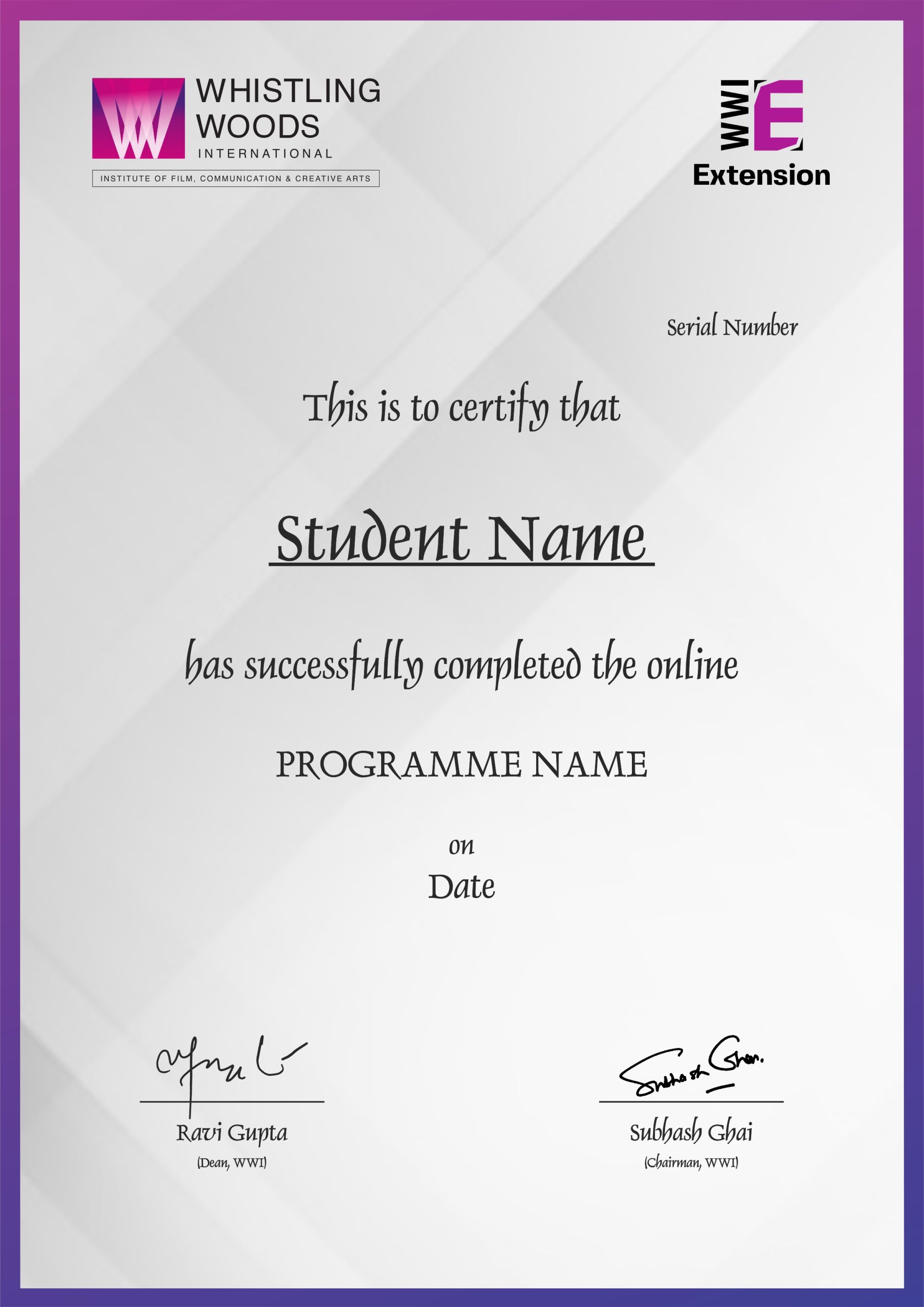
On successful completion of all the modules included in this programme, the user shall be given a certificate from Whistling Woods International. You can download the certificate in the form of a PDF.
Is there a specific time limit for this programme?
There is no specific time limit or schedule to do a module-based programme such as this one. However, the access period to the platform is 1 year
How many hours of study are required to complete this programme?
This is a module-based programme, so there is no specific schedule to adhere to.
What are the key topics covered in this programme?
Please refer to the curriculum tab on the programme page of the programme.
What type of learning should I expect from this programme?
This programme comprises of learning through video-based lectures. You will also be given the transcripts of these lectures. The content is derived from the knowledge base of Whistling Woods faculty and Industry experts along with specific case studies used to explain the concepts and theories.
Are there any assignment or programmework in this programme?
There are no programmework or assignments in this programme.
Does the programme include live sessions with the faculty?
There are no live sessions included as part of this programme. However, for live sessions and on campus specialization workshops, please check our Advanced Certificate in Filmmaking programme
Affiliations

Certification

Complete all the modules in the Programme successfully to obtain this recognisation.
- Connect with a wide network of learners & professionals.
- Take a step towards discovering the world of filmmaking
Copyright © 2026 All Rights Reserved Whistling Woods International